Document a business rule change in historical reporting
In this article (7 sections)
When a business rule changes, record the old definition, new definition, effective date and treatment of historical values. A chart that combines old-rule history with new-rule current values can show a change that partly reflects measurement policy rather than operating performance.
Where possible, calculate both definitions for an overlap period and restate comparable history. Where that is not possible, show the break and explain the limit instead of implying a continuous series.
Define the policy change
Consider an original synthetic amount measure. The old rule includes completed orders only when a customer record matches. The new rule includes all eligible completed orders, retaining unmatched customers.
The versioned glossary contains this teaching distinction. January's source fixture produces 95,000 paise under the matched-customer rule and 104,000 under the current inclusive rule.
For this article, add explicitly authored December aggregates: 80,000 paise matched and 5,000 unmatched. They are illustrative comparison inputs, not an additional extracted business dataset.
Calculate a comparable view
from fractions import Fraction

months = {'December':{'matched':80000,'unmatched':5000},
          'January':{'matched':95000,'unmatched':9000}}
old = {m:v['matched'] for m,v in months.items()}
new = {m:v['matched']+v['unmatched'] for m,v in months.items()}
mixed_change = new['January']-old['December']
comparable_change = new['January']-new['December']
base_restatement = new['December']-old['December']
assert (mixed_change,comparable_change,base_restatement)==(24000,19000,5000)
assert mixed_change==comparable_change+base_restatement
assert Fraction(mixed_change,old['December'])==Fraction(3,10)
assert Fraction(comparable_change,new['December'])==Fraction(19,85)
print({'old_rule':old,'new_rule':new,
       'mixed_definition_growth_percent':30,
       'comparable_new_rule_growth_percent':float(Fraction(19,85))*100,
       'difference_bridge_paise':[19000,5000]})
Comparing January's new-rule 104,000 with December's old-rule 80,000 gives 30% growth. Comparing both months under the new rule gives approximately 22.35%. The mixed-definition difference of 24,000 contains a 5,000-paise base-period restatement component.
This bridge is arithmetic. It does not identify a causal reason for the remaining operating difference.
Publish a definition-change note
State that unmatched customers became eligible under the new rule, identify the effective date and explain whether earlier periods were recalculated. Include an overlap table where available.
| Period | Old rule | New rule | Added unmatched amount |
|---|---|---|---|
| December, illustrative | 80,000 | 85,000 | 5,000 |
| January, source fixture | 95,000 | 104,000 | 9,000 |
Keep units explicit: all values are paise. Do not relabel the measure as recognized revenue merely because it now includes more orders.
Preserve both historical meaning and current comparability
Older reports may need to remain interpretable under the definition in effect when they were issued. A restated series serves a different purpose: comparison under a common rule.
Label those versions clearly rather than overwriting every old artifact without explanation. Retain the source and contract version used for each report so a later reader can reproduce why its number differs.
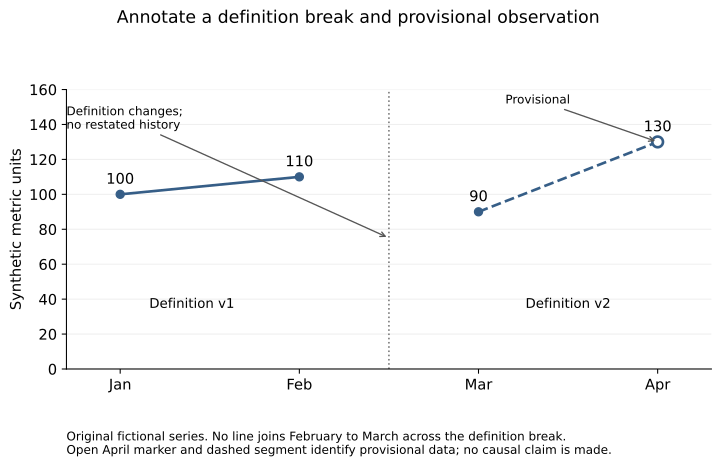
If historical unmatched records cannot be recovered, do not invent a restatement. Mark the definition break and limit trend claims across it. The annotation figure illustrates how to leave a visible gap between regimes.
Update downstream uses
Review targets, alerts, exports, executive summaries and model features that depend on the metric. A threshold calibrated under the old definition may no longer mean the same thing after eligibility expands.
Coordinate the change with the people using the report. A correct new query can still create confusion if the title, tooltip or spreadsheet export retains the old explanation.
Test the change as a contract revision
Add cases that distinguish the rules, such as an eligible unmatched order. Confirm that matched-order values remain consistent and that the new total reconciles to matched plus unmatched contributions.
Exercise: assume December's unmatched amount is unavailable. Write a chart note and executive summary that preserve the January result without claiming a comparable 30% operating increase.
NeuraPath's Data Analytics with Generative AI course connects metric definitions with reporting maintenance. A transparent rule-change record helps teams interpret differences without confusing a new measurement policy with a new business outcome.
Continue learning
This article is part of the Metrics, visualization and decision communication sequence. Use the neighbouring tasks when you need the prerequisite or the next application.
- Review the prerequisite or neighbouring task in Choose actionable thresholds instead of arbitrary red and green bands.
- Continue with Create an analysis handover with assumptions and open questions.
Pankit Kumar has 10 years in Data Science & AI, building and shipping production systems in regulated pharma and clinical environments. He is a freelance trainer at Boston Institute of Analytics, AnalytixLabs and Scaler, and has taught this material to thousands of working professionals.
This article is part of our Data Analytics with Generative AI programme — 3–4 months. The full analyst stack — Excel, SQL, Power BI and Python pipelines — then a generative-AI layer you can prove is right.
Explore Data Analytics with Generative AI